Monday, August 27, 2012

IRELAND - PART II

I suppose you could say our trip to Ireland was divided into four segments.  The first two segments I have already spoken about: the first being Dublin, and the second being the scenic and rugged west coast of the island. The next two segments involved castles and family. In this blog post I'll write about the castles. In IRELAND - PART III, I'll report on the visit with family.

After our two days and three nights in Killarney, and our visits to the Dingle Peninsula, the Burren, and the Cliffs of Moher (with brief stops in Galway and Limerick) we spent our first night in a castle. This castle was Dromoland.


We were only here for one night, but the staff was wonderful and we felt like royalty. The breakfast was to die for.  The next morning we left to drive through Connemara.  Along the way we saw the famous Connemara ponies, lobster pots in inlets, thousands of sheep, and this gorgeous site: Kylemore Abbey.


You may have seen this view in travel brochures of Ireland.  Once a private residence, it served as a school for girls for many years.  Now it is home to the Benedictine nuns.  Lucky ladies!

Our day ended at Ashford Castle, where we checked in for two nights.


The bridge leading to this castle was used in the movie The Quiet Man with John Wayne.  The small village of Cong down the road was also used. 


The castle was elegant and amazing.  Dinners were formal affairs and breakfast was an exercise in indulgence.  The first night, we were unable to get a table in the formal dining room, so we crossed the bridge to Cullen's Cottage, a lovely and less formal restaurant.  The staff was every bit as attentive, however and the food was excellent. We joked with the waiters about the pictures on the wall - every one of them was crooked.  One said, "We didn't hang them, but we like it when someone else does a bad job, because then we can complain but have no responsibility to fix it.  If you come back here next year, it will look exactly the same."  I kind of liked that philosophy.


But beyond the beauty and luxurious surroundings of the castle, there were also activities that were quite memorable. The first involved falconry, with a small Peruvian Hawk named "Inca."


This Irish beauty brought Inca to us and then Conner, our guide, took us out to the "Scary forest" and taught Tony how to handle Inca.


She performed beautifully, taking off and returning with each movement of Tony's hand, but then she found a stick and wanted to play with it on the ground. 
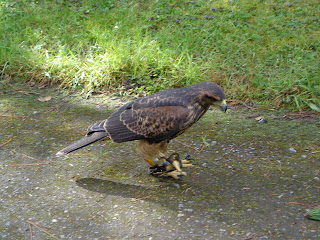
 
 
I believe this was one of the highlights of the trip for Tony.  In these past few years, he's taken up bird-watching, and he has always loved watching the hawks in our neighborhood.  I don't think he ever thought he'd get this close to such a beautiful animal. 

The afternoon turned to a more serious pursuit of nature and history.  We took a boat across Lake Corrib to the island known as Inchagoill, or "Island of the Stranger."  According to local legend, when St. Patrick came to this area of Ireland he was not greeted warmly by those who still practiced the Druid religion, and was exiled to the island along with his nephew and navigator, Lugnad.  They stayed there a while and built a stone church, the ruins of which are still there.


There is a small graveyard next to the ruin, with the stone marking the grave of Lugnad, who died on the island in the mid-5th century.  St. Patrick escaped somehow, and later, in the 12th century, Augustinian monks built a small church on the island, to use for a retreat center.  It was called the Church of Saints because of the heads of "the 10 Saints of Lake Corrib" over the entry door.


Our stay at Ashford ended with another glorious breakfast and then we headed back to Dublin to pick up a rental car, attempt to drive on the left hand side of the road and find our way to County Laois and my newly discovered cousins. 

That part of the story will be told in IRELAND - PART III


Sunday, August 26, 2012

IRELAND- PART I

We've just returned from two weeks in Ireland and the visions and memories are permantantly etched in my mind.  We had a truly memorable and wonderful time. 

First, it should be said that this journey might never have taken place were it not for my desire to connect with the culture of my ancestors.  There is something about being part of an Irish family, even if the family isn't one hundred percent Irish, that lures you to that small island across the Atlantic.  The stories you heard growing up, the myths and legends, the songs, the hardships, the history, the parades in honor of St. Patrick all make you want to visit  and see what those great great grandparents left behind, and why they brought so much of it with them. 

Our trip started off in Dublin and we got a glimpse into over 1000 years of Irish history - from the prehistoric and then Celtic origins, to the invasion of Vikings, to the conquest of the Normans,  to the British rule, and to the many rebellions against that rule, most of them ending in disaster.  The place that I found both fascinating and haunting was Kilmainham Gaol, the jail where the leaders of the 1916 Easter rising were imprisoned and executed.  Here is the Jail:


And here is the place of execution:


Of course, we saw many other sites in Dublin, including Dublin castle, which really isn't much of a castle, the General Post Office, where you can still see bullet holes from the Easter Rising, the Guinness Storehouse and Jameson Distillery, Grafton Street, Trinity College and the Book of Kells, the River Liffey, the Cathedrals, the Dublin Writer's Museum, the Statues of James Joyce and Oscar Wilde, the visitors from Galway and Cork wearing their colorful jerseys and walking to the semi-final hurling match, even a parade - not in honor of St. Patrick, but a surprise LGBT parade in support of gay marriage.


After three days we left for Killarney and the Dingle Peninsula. Along the way, we stopped at the  1000 year old Cahir Castle in County Tipperary.  Here are a few pictures:


 From Killarney, we toured the Dingle Peninsula.  The raw beauty of this windswept, Emerald landscape was breathtaking.  We saw fields and fields of sheep, grazing with a view of the Atlantic Ocean. 


 Along the way, we saw an ancient bee hive hut, where monks once lived solitary existences.
 

The following day it rained, but we braved the weather and rode through Killarney National Park in a horse drawn buggy.


Then we headed over to Muckross House, a nineteenth century mansion which was stunning in its beauty and opulence.  Built in 1843, just three years before the Great Famine in Ireland, it is almost unbelievable that people could live in such splendor when thousands of families, only a few miles away, were starving to death.


Queen Victoria visited Muckross House in 1861, the year my great great grandparents came to America.  It is said the owners spent three years preparing for her visit, and went bankrupt in the process.

The next day we visited the village of Adair with its thatched roof cottages -


And the Cliffs of Moher -


Then our drive took us to The Burren, a barren and strange lanscape formed when the ice receded from the last ice age.  It stretched for miles and miles.


Appearing here and there throughout this landscape are ancient Druid Tombs, dating back to thousands of years before Christ. 


We also passed through Limerick, and saw some landmarks from Frank McCourt's book, Angela's Ashes.  Then we headed to Dromoland Castle to begin the second half of our journey, and the long anticipated meeting with the cousins.  That part of the trip will be presented in IRELAND - PART II


Saturday, August 4, 2012

Double Excitement

Two things converge in the next two weeks week: the beginning and ending of two projects and experiences.  My husband and I leave for Ireland on Wednesday and will meet some distant Irish cousins for the first time.  This will hopefully be the beginning of a relationship with my Irish cousins, and a good start to the Brennan family history I want to write.

At the same time, my husband and I are ending a project on his family.   The Eterovich-Yeseta family history book is being completed at a printer here in the United States. 

We will be in Ireland for two weeks and one of the highlights of the trip will be a visit to Aghaobe Abbey and a celebration with my new cousins.  The Abbey is a ruin of a 6th century building, rebuilt in about the 11th century, with only its walls standing. 


There will be a Mass celebrated, and then a gathering at the home of one of my cousins with whom I have been corresponding for several years.

When we return, we will hopefully be greeted by a box containing the family history books which we will then distribute to my husband's relatives.  It is so exciting to be concluding a two year long project, which we hope will bring much joy to my husband's family.  

I hope to have much more to blog about in the coming weeks.  For now, here's the cover of the book. 


Wednesday, July 25, 2012

Irish - American families in the 20th century

We leave for Ireland in two weeks and I'm updating the American Brennan tree to show my cousins in Ireland.  I'm searching the recently released 1940 census records as well as new databases that have shown up on ancestry in the past year (when I have mostly been busy finishing my husband's paternal family history book - which is now at the printers).

Sometimes in genealogy, you find something interesting, something you actually hadn't given any thought to, such as how circumstances in the nation might affect the marriage rate and numbers of children and grandchildren in a given family.  Recently I found some interesting data along those lines regarding my family.

My great great grandparents, Ned and Mary, came here in 1861 and had six children, five of whom married and had large families.  Mary Ann, their oldest, had 9 children.  Michael, the oldest boy, also had 9 children.  Bridget had 5.  Edward had 7, and my great grandfather John had 8.  Only Sarah remained single.  But the next generation held a different story.  Some of the children of Ned and Mary had fewer grandchildren than children. Granted, some of the records are hard to find, but one thing stands out: many of the male grandchildren of Ned and Mary never married, and a number of the female grandchildren didn't marry until they were in their forties. There was at least one nun and one priest in this group, so they obviously didn't have children, but many of the others were childless as well.

We're talking about people who were born between the late 1800s and the early 1900s. The youngest of the bunch, one of my great uncles, was born in 1917. 

So I began to ask myself why this was so. Why did so many never marry or marry so late?  And one of the clues came in the draft card registrations for the men.  While most of the young men had a job in 1918 when they registered for the WW I draft, they often listed themselves as unemployed on their WW II draft cards.  I assume this must have been because of the depression, which lasted from 1929 up until WW II.  These men, having no income, must have not been good marriage prospects.  Even if they wanted to marry, they had no means to support a wife and children.  I imagine a good number of them were depressed or despondent over this situation as well, making them poor company to women.  On the women's part, it may not have been easy to find a man with a good income.  Hence, many of them either remained at home, found employment in another town or state, and married in their forties and never had children.

It made me stop and think how the economic situation of the country can affect more than just income levels.  It can actually slow down the rates of marriage and the numbers of children born.  An it can leave a lot of people without the lifelong companionship of a spouse - which I find very sad.

Friday, July 6, 2012

Brennan-Fahey Family Update

 My great great grandfather, Ned (Edward) Brennan came to America from Ireland in 1860.  A few months later, his wife, Mary Fahey Brennan, arrived in New York and there had her first child.  Her widowed mother, Sally Finn Fahey, supposedly accompanied her on the journey. Mary Brennan's father, John Fahey, had died some years before the journey.  While I have a few names that may or may not be the parents of Ned Brennan, I have little else to tell me about his ancestors.  Since most census records prior to 1901 have been destroyed for various reasons, it is quite difficult to trace ancestry in Ireland.  So, six weeks ago I hired a research company in Ireland to see if anything could be found on my Brennan and Fahey ancestors.

Yesterday, I received the report and it was quite disappointing.  Griffith's valuation, an 1850 survey of landowners and tenants, lists an Edward Brennan leasing land in the townland of Gortnaclae, the area in which he had lived prior to emigrating.  However, there are no baptismal records for Ned Brennan in Gortnaclae, so this indicates he and his family may have come from somewhere else.  Where that might be, I have no idea.

Also, by 1858, according to the Cancelled Books, which update ownerships and land leases, Edward Brennan appears to have left the district. 

There are baptismal records for a Mary Fahey close to the area from which she came, and close to the approximate date of her birth in 1833.  The parents listed were John Fahey and Sally Finne.  John Fahy and Sally Finn or Finne had two other children, baptized in the same parish:  Patrick in 1835 and Judy in 1837.  These dates are close to the dates of the births of Mary's known siblings, who also came to America, but their names were John and Julia, not Patrick and Judy.  It is possible, of course, that Patrick's middle name was John and he went by that once he came to America, and that Judy used Julia once she arrived here.  But I can't be certain of that, so I'm not certain this is the correct family.  As for dates, Irish immigrants often were vague on their actual birthdates, whether by ignorance or design I'm not sure. 

We'll be leaving for Ireland in less than 5 weeks and hope to spend some time with a cousin there who has offered to take us to the old Brennan homestead.  Perhaps he or another family member can give me a better idea of how long the Brennan family lived there and where they might have come from before that.  At this point, that is the only remaining way for me to find more clues. 

Saturday, June 30, 2012

Finding Another Lost Family Member

My husband and I made another trip to the cemetery yesterday to find a lost family member.  This was the wife of my husband's great uncle.  She was born on a small island off the Dalmatian Coast in 1878 and came to the United States in 1912 with her two daughters.  Her husband had arrived some years earlier. She died sometime before 1920, when in the census for that year her husband states he is a widower, but we did not know the date of her death, nor the circumstances.  In speaking with her living descendants, we were unable to gain any new information other than the possibility she had died in childbirth.

In a previous trip to the cemetery, we had been unable to find her grave.  Even the office staff was unable to find her name in the large pre-computer record books.  However, I decided to give it another try (sometimes one cemetery staff member is more adept than another) and this time the cemetery staff found her.  She was buried, they told us, with a baby.  She had died on the day of the baby's birth and the baby had died a few days later. The staff member gave us the location of the grave.

We went to the location they gave us and couldn't find the headstone.  We walked all over, but could not find it.  We began to think that there was no headstone, that perhaps the family had never purchased one, and we went back to the cemetery office.  They looked it up again and found that there was, indeed, a headstone, but it had only been purchased in 1991.  They also sent a staff member out to help us find the grave and it was not where they had originally directed us. 

This is eventually what we found:


The glare of the sun makes the image less clear than we would have liked, but if you look carefully, you can see the name "Dora Eterovich"  and the word "baby" below it. This appeared to confirm our theory that Dora died in childbirth.  And we were finally able to determine the year of her death.  We spent a few minutes at the grave, reflecting on the tragedy of dying at such a young age and leaving children behind.  Then we went on to find other family members and pay our respects. 

Tuesday, May 29, 2012

Portrait of a Family

When you spend your days learning things about your ancestors - three, four, ten, even fifteen generations ago - you come to think you know them just a little. In most cases, you can only imagine what they looked like as you obviously never met anyone past a great grandparent - if you even met them.  So anytime you can find a picture of an ancestor, it is like finding treasure. 

Yesterday I was working on the Shaw side of my family tree - my paternal grandmother's side - when I found a link to a picture I had never seen before.  Someone from Ohio put it up on ancestry.com.  I don't know if he's a relative, or just someone who searches through records and puts things up.  I've also come across the name of this man in connection with my maternal side of the family and I doubt he's related to both sides, although it is possible, I suppose. 

Anyway, the picture is a group photo and it was taken in about 1903. It's not in great shape.  There are two obvious places in the photograph where someone cut it as if to remove certain people from the others.  Don't know if it was deliberate, or some 5 year old child got ahold of the picture and practiced their scissors work on it.  It actually looks deliberate to me, and that makes me curious.  Was there a falling out between members of this family?


The man on the top left is my paternal great grandfather, and below him, holding a little girl, is my paternal great grandmother.  My own grandmother had not yet been born when this picture was taken.  The two people in the middle of the picture are my great great grandparents.  The man with the beard was Jacob Burden, the woman to his left Rebecca Lippincott Burden.  They had 5 children.  But Jacob had been married previously and had 4 children with his first wife.  Both sets of children are in this picture, along with spouses and grandchildren.

This picture is remarkable to me for many reasons - the fact that so many family members are gathered for one photograph.  The fact that it's not in a studio, but outside.  The fact that someone with a quality camera took it.  The fact that so many family members are living.  The fact that it even survived.  But even more remarkable to me is how attractive this family is - how much (aside from the clothing), many of them could fit in today in our society.  The children look much like other children I see running around today and the adults are all so handsome and healthy looking.  I've seen many pictures from this time period and the people in them look like they belong in the early 1900s.  These people don't.  They seem more vibrant and alive to me.  Perhaps it's the way some of the woman are holding their babies, or the the way some of them have their hands on others' shoulders, or the way the little boy, fourth from left, has his arms crossed and a scowl on his face as if he finds this whole enterprise boring and he just wants to run off and have some fun.  Some of them look as if they could simply jump off the page. 

This picture, as so many pictures, is a reminder that people who are no longer here were once alive and happy, working and playing, loving their children and sometimes grieving over the loss of someone.  They were as alive as we are now - and that is one of many reasons I love photographs that bring them back to life, if only on paper.