My DNA results are in and they are largely what I expected. My ancestry is 51 percent Central European - which includes Austria, Belgium, France, Germany, Netherlands, Switzerland, and Luxembourg. Since nearly all the ancestors on my mother's side are from Germany and Belgium, this isn't surprising.
Also not surprising is the fact that 38 percent of my ancestry is from the British Isles, which includes England, Ireland, Scotland and Wales. On my father's side, there are many ancestors from Ireland as well as England.
The one surprise is that 8 percent of my ancestry is from Eastern Europe, an area that includes Poland, Greece, Croatia, Hungary, Romania, Bulgaria, Belarus and Ukraine, among other countries. Since I have not identified any ancestors who came from this area, some early ancestors must have migrated from there to either Germany, Belgium, England or Ireland quite a long time ago. The information provided regarding the DNA results states that your personal DNA sample may include DNA that is not reflected in your family tree because it dates from thousands of years ago.
There are a few empty spaces on my family tree. I have one great great grandfather on my father's side that I have been unable to identify, and one set of great great great grandparents on my mother's side who are not identified. In addition, there are many ancestors who go back further than that who remain unidentified.
Although my husband has not had his DNA analyzed, we already know we share roots from the British Isles and Central Europe, as he has ancestors from England and Switzerland. We now know we share Eastern European roots. His results, were he to have his DNA analyzed, would show at least 25 percent Eastern European Ancestry and probably the same from the British Isles.
I was a little disappointed that there was no Native American ancestry as I had heard occasional rumors of that possibility. But there is 3 percent of my DNA that is labeled "uncertain," so perhaps that is still possible.
As part of the report I was given the names of other family trees on ancestry that contain, with 95 percent certainty, some of my distant cousins. Now I will decide whether or not to reach out to any of them. Perhaps they will be able to provide more clues to solve the remaining family mysteries.
Wednesday, October 24, 2012

Sunday, October 14, 2012
DNA
I took advantage of a special offer by ancestry.com and am having my DNA analyzed. Here's the kit that they sent me to collect a sample of saliva.

It's a simple procedure. You just collect a small sample of saliva, seal the sample up in a special bag and enclose it in the pre-addressed and stampled padded envelope.
I've already received notice that they received my sample and will send me my results via email in 4 to 6 weeks.
So what can I expect to learn? First, I will learn the various ethnicities that make up my ancestral history. While I already have a pretty good idea of who my ancestors were and the countries they came from, there may be some surprises - perhaps I'll find that rumored but unknown Native American ancestor. Or I might find that some ancestors came from Eastern Europe before they made their way to the British Isles or Germany.
I'll also be directed to potential ancestors on other ancestry.com family trees who share some of my DNA patterns.
I don't really expect any surprises, but I'm anxious to see the results nonetheless. It's just one more clue to solving the family mystery.

It's a simple procedure. You just collect a small sample of saliva, seal the sample up in a special bag and enclose it in the pre-addressed and stampled padded envelope.
I've already received notice that they received my sample and will send me my results via email in 4 to 6 weeks.
So what can I expect to learn? First, I will learn the various ethnicities that make up my ancestral history. While I already have a pretty good idea of who my ancestors were and the countries they came from, there may be some surprises - perhaps I'll find that rumored but unknown Native American ancestor. Or I might find that some ancestors came from Eastern Europe before they made their way to the British Isles or Germany.
I'll also be directed to potential ancestors on other ancestry.com family trees who share some of my DNA patterns.
I don't really expect any surprises, but I'm anxious to see the results nonetheless. It's just one more clue to solving the family mystery.
Thursday, October 4, 2012
The Book is Finished
A few days after we returned from Ireland, the completed family history books were delivered.

After nearly two years of research and writing, it was gratifying to see the finished product.
The book contains several sections, including sections on the ancestors and descendants of Anton Eterovich (Terich) and Madalena Yeseta, my husband's grandparents. It also includes sections on their brothers and sisters, and their descendants, complete with pictures. There is a section on the history of the island of Brac as well as a section on the history of Bohemia, the two places from which the ancestors came. There is also a section on Croatian immigration and a description of Los Angeles in 1910, when most of the Croatian ancestors arrived. In the center of the book are 9 pages of wedding photos spanning a century. Finally, there is a large section on Croatian recipes.
After receiving the books, I prepared them for mailing. Earlier, I had recieved checks from the relatives for the book and postage. Nearly 40 relatives asked to have the book mailed, so on a Saturday, my husband and I carted 4 boxes of books in padded envelopes into the local Post Office. Since then, I have heard from a number of relatives who are thrilled with the book.
I have also personally delivered a few of the books and my husband and I will be going to a book signing party this Sunday. I'm really looking forward to that.
In future posts I will outline how I went about researching, writing and designing the book, for any of you who might be interested in writing a book of your own.

After nearly two years of research and writing, it was gratifying to see the finished product.
The book contains several sections, including sections on the ancestors and descendants of Anton Eterovich (Terich) and Madalena Yeseta, my husband's grandparents. It also includes sections on their brothers and sisters, and their descendants, complete with pictures. There is a section on the history of the island of Brac as well as a section on the history of Bohemia, the two places from which the ancestors came. There is also a section on Croatian immigration and a description of Los Angeles in 1910, when most of the Croatian ancestors arrived. In the center of the book are 9 pages of wedding photos spanning a century. Finally, there is a large section on Croatian recipes.
After receiving the books, I prepared them for mailing. Earlier, I had recieved checks from the relatives for the book and postage. Nearly 40 relatives asked to have the book mailed, so on a Saturday, my husband and I carted 4 boxes of books in padded envelopes into the local Post Office. Since then, I have heard from a number of relatives who are thrilled with the book.
I have also personally delivered a few of the books and my husband and I will be going to a book signing party this Sunday. I'm really looking forward to that.
In future posts I will outline how I went about researching, writing and designing the book, for any of you who might be interested in writing a book of your own.
Tuesday, August 28, 2012
IRELAND - PART III, CONNECTING WITH FAMILY
We left Ashford Castle with a driver who took us to the Dublin Airport to pick up a car, and hoped we could figure out how to drive on the left hand side of the street. We then headed to County Laois and our new accomodations: The Roundwood House.

We arrived and looked around at this mansion built in the 1700s and refurbished several times, most recently in the 1980s. A young couple runs the place, the daughter and son in law of the former owners who still live on the property. (Obviously they weren't the original owners.) They were quite welcoming, though it was a little odd to be staying in someone else's house with no locks on the bedroom doors.
After settling in, we were ready to begin the highlight of our trip - spending time with family we had never met. I called my cousin Canice from the inn and he came to meet us at 5:30 and took us on a tour of the surrounding area and sites of significance to my family. First, we stopped at Aghaboe Abbey, orginally built in the 6th century and destroyed in 1346. The present day building is a ruin of a Dominican friary that was built in 1382 and has been preserved by the local community.


.JPG) This is as close as I will ever get to where my ancestors once lived.
This is as close as I will ever get to where my ancestors once lived.
We also drove past a slight mound on a local farmer's property. It was overgrown with foliage. Canice identified it as Kyletabreecheen (or what a cousin, Father Bob Brennan, called Killabrigeen in his book Irish Diary), the abandoned cemetery where many of my Brennan ancestors are buried. I wanted to explore the area, but Canice said there was nothing to see as there are no headstones.

Our next stop was the Chapel of Clough, or Aghaboe Chapel, where my great great grandparents, Ned and Mary, were married in 1860. The building is no longer a chapel and is now a community center. The only hint that it was once a chapel is the graveyard adjacent to it.

The final stop on our evening tour was the home where Canice grew up, and the house and barn owned originally by his great grandparents, James and Mary Brennan Clooney. (Mary was the sister of my great great grandfather, Ned.)


The home is on Canice's farm, and his own bungalow, where he lives with his wife, Maura, is just down the lane. He took us there to meet her and she fixed us a nice tea. We had a lovely visit.
The next morning, Tony and I visited Kilkenny and toured its castle.

We also drove around the area to see the many towns and villages whose names I've seen in census records as I've worked on my genealogy. That evening, we joined Canice and Marua and about 50 members of the local community at a mass at the Abbey, said for those who are buried in the cemetery.

.jpg)
We were told by a local that at this time of the year, masses are said in cemeteries throughout Ireland. Here, they really remember those who have passed on, and every tiny village seems to have its own cemetery, which is a continual reminder of the connection between the living and the dead.
Afterwards, we joined Canice and his family for tea at the house. Maura insisted everyone sing a song, so each of us had to think of something to sing. Tony and I sang a duet, but everyone else sang alone, mostly 20-verse Irish ballads they've been singing for years. It was wonderful to feel a part of this large and thoroughly Irish family.


We arrived and looked around at this mansion built in the 1700s and refurbished several times, most recently in the 1980s. A young couple runs the place, the daughter and son in law of the former owners who still live on the property. (Obviously they weren't the original owners.) They were quite welcoming, though it was a little odd to be staying in someone else's house with no locks on the bedroom doors.
After settling in, we were ready to begin the highlight of our trip - spending time with family we had never met. I called my cousin Canice from the inn and he came to meet us at 5:30 and took us on a tour of the surrounding area and sites of significance to my family. First, we stopped at Aghaboe Abbey, orginally built in the 6th century and destroyed in 1346. The present day building is a ruin of a Dominican friary that was built in 1382 and has been preserved by the local community.

The adjacent cemetery is where many members of the family are buried.

Next, Canice drove past a small dirt road where my great great grandfather, Ned Brennan, lived in 1860, before he came to America. There are no houses there now, but Canice said there once were 14 homes on the lane, probably the simple stone houses whose remains dot the landscape of rural Ireland. .JPG)
We also drove past a slight mound on a local farmer's property. It was overgrown with foliage. Canice identified it as Kyletabreecheen (or what a cousin, Father Bob Brennan, called Killabrigeen in his book Irish Diary), the abandoned cemetery where many of my Brennan ancestors are buried. I wanted to explore the area, but Canice said there was nothing to see as there are no headstones.

Our next stop was the Chapel of Clough, or Aghaboe Chapel, where my great great grandparents, Ned and Mary, were married in 1860. The building is no longer a chapel and is now a community center. The only hint that it was once a chapel is the graveyard adjacent to it.

The final stop on our evening tour was the home where Canice grew up, and the house and barn owned originally by his great grandparents, James and Mary Brennan Clooney. (Mary was the sister of my great great grandfather, Ned.)

He even took us on a tour of the interior of the house, where we saw an old turf-burning stove downstairs and four poster brass bed upstairs. 

The home is on Canice's farm, and his own bungalow, where he lives with his wife, Maura, is just down the lane. He took us there to meet her and she fixed us a nice tea. We had a lovely visit.
The next morning, Tony and I visited Kilkenny and toured its castle.

We also drove around the area to see the many towns and villages whose names I've seen in census records as I've worked on my genealogy. That evening, we joined Canice and Marua and about 50 members of the local community at a mass at the Abbey, said for those who are buried in the cemetery.

.jpg)
We were told by a local that at this time of the year, masses are said in cemeteries throughout Ireland. Here, they really remember those who have passed on, and every tiny village seems to have its own cemetery, which is a continual reminder of the connection between the living and the dead.
Afterwards, we joined Canice and his family for tea at the house. Maura insisted everyone sing a song, so each of us had to think of something to sing. Tony and I sang a duet, but everyone else sang alone, mostly 20-verse Irish ballads they've been singing for years. It was wonderful to feel a part of this large and thoroughly Irish family.

The next day, our final day in Ireland, we drove to Rathdowny, home of my great great Grandmother, and Castlecomer, a Brennan stronghold to this day.

Then it was time to return to Canice's house for lunch, but we were distracted by the sight of what could only have been a workhouse, set up during the time of the famine. Sure enough, it was a workhouse that had been made into a museum and it was grim. Men, women and children were housed separately, all slept on straw on the floor and worked very hard for very little food. It was a gruesome existence, but it was the only thing between some of the starving population and death.

We spent about 20 minutes at the museum, and then got lost on the way to Canice's. There are no street signs and you simply have to know the lanes and roads, which we don't. Finally we arrived and had a lovely visit where I gave Canice a copy of my book and some family pictures and family history. He showed me the letters he had kept from my father. Sooner than we knew it, it was time to leave, which wasn't easy. Canice and Maura invited us to return, and we said we would. Hopefully we'll be able to keep that promise.

Ellen and Canice at the Abbey

Monday, August 27, 2012
IRELAND - PART II
I suppose you could say our trip to Ireland was divided into four segments. The first two segments I have already spoken about: the first being Dublin, and the second being the scenic and rugged west coast of the island. The next two segments involved castles and family. In this blog post I'll write about the castles. In IRELAND - PART III, I'll report on the visit with family.
After our two days and three nights in Killarney, and our visits to the Dingle Peninsula, the Burren, and the Cliffs of Moher (with brief stops in Galway and Limerick) we spent our first night in a castle. This castle was Dromoland.

.JPG)
We were only here for one night, but the staff was wonderful and we felt like royalty. The breakfast was to die for. The next morning we left to drive through Connemara. Along the way we saw the famous Connemara ponies, lobster pots in inlets, thousands of sheep, and this gorgeous site: Kylemore Abbey.

You may have seen this view in travel brochures of Ireland. Once a private residence, it served as a school for girls for many years. Now it is home to the Benedictine nuns. Lucky ladies!
Our day ended at Ashford Castle, where we checked in for two nights.

The bridge leading to this castle was used in the movie The Quiet Man with John Wayne. The small village of Cong down the road was also used.

The castle was elegant and amazing. Dinners were formal affairs and breakfast was an exercise in indulgence. The first night, we were unable to get a table in the formal dining room, so we crossed the bridge to Cullen's Cottage, a lovely and less formal restaurant. The staff was every bit as attentive, however and the food was excellent. We joked with the waiters about the pictures on the wall - every one of them was crooked. One said, "We didn't hang them, but we like it when someone else does a bad job, because then we can complain but have no responsibility to fix it. If you come back here next year, it will look exactly the same." I kind of liked that philosophy.

But beyond the beauty and luxurious surroundings of the castle, there were also activities that were quite memorable. The first involved falconry, with a small Peruvian Hawk named "Inca."

This Irish beauty brought Inca to us and then Conner, our guide, took us out to the "Scary forest" and taught Tony how to handle Inca.

She performed beautifully, taking off and returning with each movement of Tony's hand, but then she found a stick and wanted to play with it on the ground.
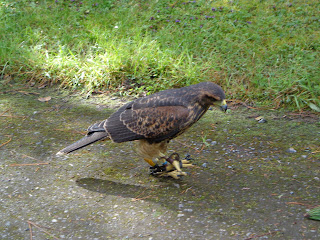 I believe this was one of the highlights of the trip for Tony. In these past few years, he's taken up bird-watching, and he has always loved watching the hawks in our neighborhood. I don't think he ever thought he'd get this close to such a beautiful animal.
The afternoon turned to a more serious pursuit of nature and history. We took a boat across Lake Corrib to the island known as Inchagoill, or "Island of the Stranger." According to local legend, when St. Patrick came to this area of Ireland he was not greeted warmly by those who still practiced the Druid religion, and was exiled to the island along with his nephew and navigator, Lugnad. They stayed there a while and built a stone church, the ruins of which are still there.
.jpg)
There is a small graveyard next to the ruin, with the stone marking the grave of Lugnad, who died on the island in the mid-5th century. St. Patrick escaped somehow, and later, in the 12th century, Augustinian monks built a small church on the island, to use for a retreat center. It was called the Church of Saints because of the heads of "the 10 Saints of Lake Corrib" over the entry door.
.jpg) Our stay at Ashford ended with another glorious breakfast and then we headed back to Dublin to pick up a rental car, attempt to drive on the left hand side of the road and find our way to County Laois and my newly discovered cousins.
Our stay at Ashford ended with another glorious breakfast and then we headed back to Dublin to pick up a rental car, attempt to drive on the left hand side of the road and find our way to County Laois and my newly discovered cousins.
That part of the story will be told in IRELAND - PART III
After our two days and three nights in Killarney, and our visits to the Dingle Peninsula, the Burren, and the Cliffs of Moher (with brief stops in Galway and Limerick) we spent our first night in a castle. This castle was Dromoland.

.JPG)
We were only here for one night, but the staff was wonderful and we felt like royalty. The breakfast was to die for. The next morning we left to drive through Connemara. Along the way we saw the famous Connemara ponies, lobster pots in inlets, thousands of sheep, and this gorgeous site: Kylemore Abbey.

.JPG)
You may have seen this view in travel brochures of Ireland. Once a private residence, it served as a school for girls for many years. Now it is home to the Benedictine nuns. Lucky ladies!
Our day ended at Ashford Castle, where we checked in for two nights.

The bridge leading to this castle was used in the movie The Quiet Man with John Wayne. The small village of Cong down the road was also used.

The castle was elegant and amazing. Dinners were formal affairs and breakfast was an exercise in indulgence. The first night, we were unable to get a table in the formal dining room, so we crossed the bridge to Cullen's Cottage, a lovely and less formal restaurant. The staff was every bit as attentive, however and the food was excellent. We joked with the waiters about the pictures on the wall - every one of them was crooked. One said, "We didn't hang them, but we like it when someone else does a bad job, because then we can complain but have no responsibility to fix it. If you come back here next year, it will look exactly the same." I kind of liked that philosophy.

But beyond the beauty and luxurious surroundings of the castle, there were also activities that were quite memorable. The first involved falconry, with a small Peruvian Hawk named "Inca."

This Irish beauty brought Inca to us and then Conner, our guide, took us out to the "Scary forest" and taught Tony how to handle Inca.

She performed beautifully, taking off and returning with each movement of Tony's hand, but then she found a stick and wanted to play with it on the ground.
The afternoon turned to a more serious pursuit of nature and history. We took a boat across Lake Corrib to the island known as Inchagoill, or "Island of the Stranger." According to local legend, when St. Patrick came to this area of Ireland he was not greeted warmly by those who still practiced the Druid religion, and was exiled to the island along with his nephew and navigator, Lugnad. They stayed there a while and built a stone church, the ruins of which are still there.
.jpg)
There is a small graveyard next to the ruin, with the stone marking the grave of Lugnad, who died on the island in the mid-5th century. St. Patrick escaped somehow, and later, in the 12th century, Augustinian monks built a small church on the island, to use for a retreat center. It was called the Church of Saints because of the heads of "the 10 Saints of Lake Corrib" over the entry door.
.jpg)
That part of the story will be told in IRELAND - PART III


Sunday, August 26, 2012
IRELAND- PART I
We've just returned from two weeks in Ireland and the visions and memories are permantantly etched in my mind. We had a truly memorable and wonderful time.
First, it should be said that this journey might never have taken place were it not for my desire to connect with the culture of my ancestors. There is something about being part of an Irish family, even if the family isn't one hundred percent Irish, that lures you to that small island across the Atlantic. The stories you heard growing up, the myths and legends, the songs, the hardships, the history, the parades in honor of St. Patrick all make you want to visit and see what those great great grandparents left behind, and why they brought so much of it with them.
Our trip started off in Dublin and we got a glimpse into over 1000 years of Irish history - from the prehistoric and then Celtic origins, to the invasion of Vikings, to the conquest of the Normans, to the British rule, and to the many rebellions against that rule, most of them ending in disaster. The place that I found both fascinating and haunting was Kilmainham Gaol, the jail where the leaders of the 1916 Easter rising were imprisoned and executed. Here is the Jail:


Of course, we saw many other sites in Dublin, including Dublin castle, which really isn't much of a castle, the General Post Office, where you can still see bullet holes from the Easter Rising, the Guinness Storehouse and Jameson Distillery, Grafton Street, Trinity College and the Book of Kells, the River Liffey, the Cathedrals, the Dublin Writer's Museum, the Statues of James Joyce and Oscar Wilde, the visitors from Galway and Cork wearing their colorful jerseys and walking to the semi-final hurling match, even a parade - not in honor of St. Patrick, but a surprise LGBT parade in support of gay marriage.

After three days we left for Killarney and the Dingle Peninsula. Along the way, we stopped at the 1000 year old Cahir Castle in County Tipperary. Here are a few pictures:


The following day it rained, but we braved the weather and rode through Killarney National Park in a horse drawn buggy.
 Then we headed over to Muckross House, a nineteenth century mansion which was stunning in its beauty and opulence. Built in 1843, just three years before the Great Famine in Ireland, it is almost unbelievable that people could live in such splendor when thousands of families, only a few miles away, were starving to death.

Queen Victoria visited Muckross House in 1861, the year my great great grandparents came to America. It is said the owners spent three years preparing for her visit, and went bankrupt in the process.
The next day we visited the village of Adair with its thatched roof cottages -

And the Cliffs of Moher -


Then our drive took us to The Burren, a barren and strange lanscape formed when the ice receded from the last ice age. It stretched for miles and miles.

Appearing here and there throughout this landscape are ancient Druid Tombs, dating back to thousands of years before Christ.

We also passed through Limerick, and saw some landmarks from Frank McCourt's book, Angela's Ashes. Then we headed to Dromoland Castle to begin the second half of our journey, and the long anticipated meeting with the cousins. That part of the trip will be presented in IRELAND - PART II
First, it should be said that this journey might never have taken place were it not for my desire to connect with the culture of my ancestors. There is something about being part of an Irish family, even if the family isn't one hundred percent Irish, that lures you to that small island across the Atlantic. The stories you heard growing up, the myths and legends, the songs, the hardships, the history, the parades in honor of St. Patrick all make you want to visit and see what those great great grandparents left behind, and why they brought so much of it with them.
Our trip started off in Dublin and we got a glimpse into over 1000 years of Irish history - from the prehistoric and then Celtic origins, to the invasion of Vikings, to the conquest of the Normans, to the British rule, and to the many rebellions against that rule, most of them ending in disaster. The place that I found both fascinating and haunting was Kilmainham Gaol, the jail where the leaders of the 1916 Easter rising were imprisoned and executed. Here is the Jail:

And here is the place of execution:
Of course, we saw many other sites in Dublin, including Dublin castle, which really isn't much of a castle, the General Post Office, where you can still see bullet holes from the Easter Rising, the Guinness Storehouse and Jameson Distillery, Grafton Street, Trinity College and the Book of Kells, the River Liffey, the Cathedrals, the Dublin Writer's Museum, the Statues of James Joyce and Oscar Wilde, the visitors from Galway and Cork wearing their colorful jerseys and walking to the semi-final hurling match, even a parade - not in honor of St. Patrick, but a surprise LGBT parade in support of gay marriage.

After three days we left for Killarney and the Dingle Peninsula. Along the way, we stopped at the 1000 year old Cahir Castle in County Tipperary. Here are a few pictures:


From Killarney, we toured the Dingle Peninsula. The raw beauty of this windswept, Emerald landscape was breathtaking. We saw fields and fields of sheep, grazing with a view of the Atlantic Ocean.


Along the way, we saw an ancient bee hive hut, where monks once lived solitary existences.

The following day it rained, but we braved the weather and rode through Killarney National Park in a horse drawn buggy.


Queen Victoria visited Muckross House in 1861, the year my great great grandparents came to America. It is said the owners spent three years preparing for her visit, and went bankrupt in the process.
The next day we visited the village of Adair with its thatched roof cottages -

And the Cliffs of Moher -


Then our drive took us to The Burren, a barren and strange lanscape formed when the ice receded from the last ice age. It stretched for miles and miles.

Appearing here and there throughout this landscape are ancient Druid Tombs, dating back to thousands of years before Christ.

We also passed through Limerick, and saw some landmarks from Frank McCourt's book, Angela's Ashes. Then we headed to Dromoland Castle to begin the second half of our journey, and the long anticipated meeting with the cousins. That part of the trip will be presented in IRELAND - PART II
Saturday, August 4, 2012
Double Excitement
Two things converge in the next two weeks week: the beginning and ending of two projects and experiences. My husband and I leave for Ireland on Wednesday and will meet some distant Irish cousins for the first time. This will hopefully be the beginning of a relationship with my Irish cousins, and a good start to the Brennan family history I want to write.
At the same time, my husband and I are ending a project on his family. The Eterovich-Yeseta family history book is being completed at a printer here in the United States.
We will be in Ireland for two weeks and one of the highlights of the trip will be a visit to Aghaobe Abbey and a celebration with my new cousins. The Abbey is a ruin of a 6th century building, rebuilt in about the 11th century, with only its walls standing.

There will be a Mass celebrated, and then a gathering at the home of one of my cousins with whom I have been corresponding for several years.
When we return, we will hopefully be greeted by a box containing the family history books which we will then distribute to my husband's relatives. It is so exciting to be concluding a two year long project, which we hope will bring much joy to my husband's family.
I hope to have much more to blog about in the coming weeks. For now, here's the cover of the book.

At the same time, my husband and I are ending a project on his family. The Eterovich-Yeseta family history book is being completed at a printer here in the United States.
We will be in Ireland for two weeks and one of the highlights of the trip will be a visit to Aghaobe Abbey and a celebration with my new cousins. The Abbey is a ruin of a 6th century building, rebuilt in about the 11th century, with only its walls standing.
There will be a Mass celebrated, and then a gathering at the home of one of my cousins with whom I have been corresponding for several years.
When we return, we will hopefully be greeted by a box containing the family history books which we will then distribute to my husband's relatives. It is so exciting to be concluding a two year long project, which we hope will bring much joy to my husband's family.
I hope to have much more to blog about in the coming weeks. For now, here's the cover of the book.

Subscribe to:
Posts (Atom)